Choosing the right VPS (Virtual Private Server) for global networking is no longer just about CPU and RAM. For power users and network architects, the most critical factor is the underlying infrastructure: whether your VPS provider routes data through Submarine Fiber Optic cables or utilizes emerging "Non-Cable" satellite links.
Why Your VPS Choice Depends on Subsea Infrastructure
When you deploy a VPS in international hubs like Singapore, Tokyo, or New York, your data packets must travel thousands of miles across oceans. A high-quality VPS provider typically utilizes Tier-1 submarine cables. These fiber-optic lines are the backbone of the internet, offering the lowest possible latency and the highest bandwidth consistency for tunneling, gaming, and enterprise applications.
| VPS Infrastructure | Routing Path | Typical Latency | Best For |
|---|---|---|---|
| Fiber-Optic VPS | Submarine Cables (Undersea) | Low (10ms - 60ms) | Gaming, Tunneling (Vless/SSH), HFT |
| Non-Cable/Satellite VPS | LEO Satellites (Space) | Medium (50ms - 100ms) | Remote Access, Offshore Hosting |
| Legacy Satellite VPS | GEO Satellites (High Orbit) | Very High (600ms+) | Basic Backup only |
Top Global VPS Providers: Submarine Fiber vs Satellite Users
To help you choose the right service, we have categorized several world-class VPS providers based on their primary network backbone. Understanding which provider owns or leases subsea capacity is vital for your connectivity strategy.
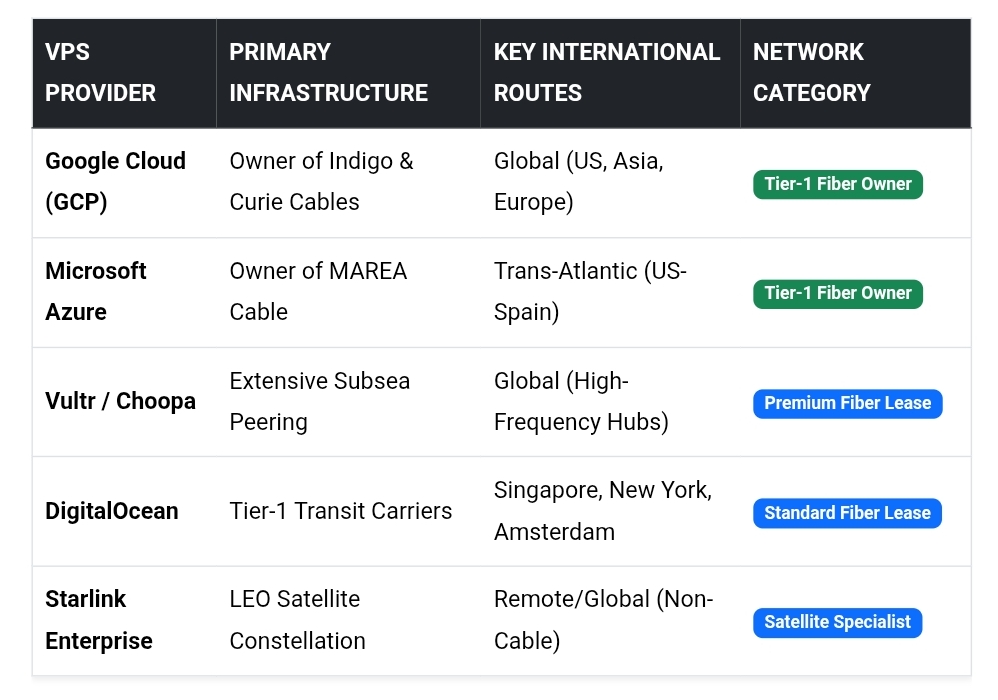
Table Providers Submarine Fiber vs Satellite Users.
Ping & Speed Comparison: Analyzing VPS Performance
To help you select the correct VPS, we must analyze how signals propagate. A VPS hosted on a fiber-backed network sends signals through glass at the speed of light. In contrast, a "Non-Cable" VPS using satellite technology must bounce signals to orbit, adding physical distance. While signals travel faster in a vacuum, the detour to space usually results in higher latency than direct undersea fiber.
International VPS Efficiency Score
*Higher score indicates lower jitter and better stability for long-distance data transmission.
Space Lasers: The Future of Non-Cable VPS?
The latest evolution in satellite-based VPS infrastructure is Inter-Satellite Laser Links (ISL). This technology allows satellites to communicate directly in a vacuum without using ground stations as relays. While this might eventually challenge submarine cables for specific routes like London to Tokyo, current undersea fiber still remains the king of raw throughput and reliability.
Final Decision: Which VPS is Right for You?
If you are an online gamer or a network specialist running Vless/Trojan tunnels, you should strictly choose a Fiber-backed VPS from providers like Google Cloud or Vultr. The stability provided by undersea glass fiber is currently unbeatable for professional use. However, for users in extremely remote areas where cables cannot reach, a satellite-linked VPS is a revolutionary alternative.
Technical Verdict
For the best balance of price and international speed, we recommend selecting a Singapore-based VPS with direct submarine fiber links. This ensures your data avoids unnecessary hops through congested terrestrial networks, resulting in a significantly smoother user experience.